

2025 ended with new opportunities, an outcome few expected at the start.
The war in Israel shifted regional priorities, but the ceasefire showed that innovation, shared interests, and practical cooperation build stronger relationships than politics.
The resilience of Israel’s tech industry and the renewed momentum it has gained since the ceasefire has been remarkable. Under rapidly evolving conditions, many of our companies, and others across the ecosystem, continued advancing, allowing cross-regional business and partnerships to move forward.
Across our portfolio, performance remained strong.
CyberArk completed a milestone $25B sale. Earnix reached record results and secured a $290M continuation fund to scale its insurance technology. ControlUp continued winning enterprise customers. ThetaRay expanded its financial crime and payments infrastructure globally, Nanit raised an additional $50M to advance its vision, and companies across our portfolio advanced vertical AI in cybersecurity, insurance, and financial services, continued driving technological breakthroughs in their sectors, introduced new capabilities, and deepened partnerships across finance, climate, and cyber.
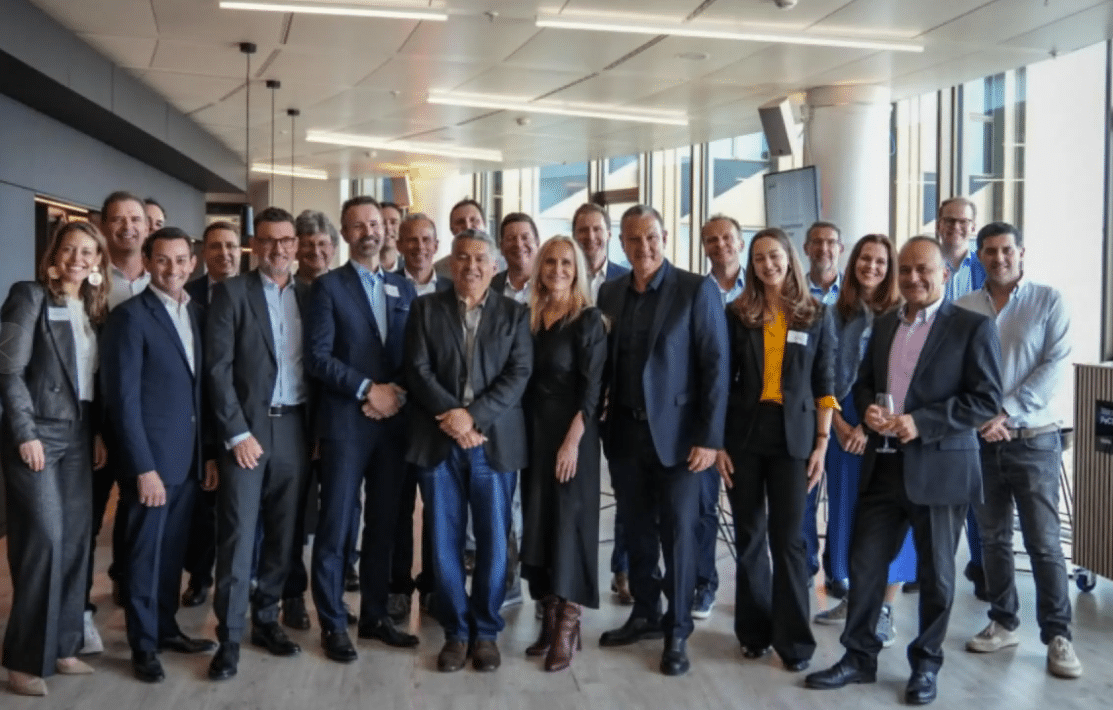
Our New York hub became a central meeting point for global insurers, banks, and enterprises, where we introduced our portfolio companies’ technologies, facilitated strategic engagements, and supported organizations from all over the world as they integrated new AI capabilities.
All while continuing to serve as a matchmaker between leading financial institutions and some of the greatest startups and ideas our ecosystems in Israel and New York have to offer, as innovation continues to thrive.
This year highlighted the power of combined forces. Our Triangle approach, Israeli innovation, New York as the global capital, and Europe as the center of advanced regulated markets, proved again to be the most effective path for scaling frontier technologies into the institutions that shape global industries, opening strategic markets, securing major partnerships, and delivering solutions where they matter most.
What to expect in 2026: AI grows up and grows deep
The next phase of AI extends beyond the horizontal tools that defined its early adoption. In 2026, it advances into a deeper and more consequential era.
Major global outlooks echo this shift. BlackRock’s 2026 Investment Outlook and McKinsey’s latest analyses both point to the same conclusion we reached this year: AI is moving out of the experimentation phase and into the core systems that govern economies, entering the vertical markets that shape each sector in a deeper and more dedicated manner.
Their forecasts highlight rising demand for transparent, regulated, domain-specific AI, along with significant investment flowing into the data and energy infrastructure required to support it. The world’s largest institutions now anticipate the very transformation we have been building toward: AI that delivers real productivity, real clarity, and real impact inside the verticals that shape daily life.
A profound shift: AI moves into the systems that run the world
While 2025 was the year the world adopted Gen-AI at a horizontal level, often geared toward every consumer, much like the early Google search revolution, 2026 shifts to the rise of vertical AI, technology dedicated to the specific needs of each industry and fully aligned with the direction we have been investing in for the past five years.
In insurance
predictions must incorporate climate dynamics like humidity, drought, wind patterns, wildfire spread, and flood likelihood. Vertical AI enables insurers to fuse dynamic environmental data with regulatory requirements in ways generic models cannot.
In global finance
Banks moving money across continents must identify illicit behavior hidden among legitimate flows. When they lack clarity about who is sending or receiving funds, transactions shut down. As global commerce accelerates and bad actors become more sophisticated, AI must read patterns across borders, jurisdictions, and languages to keep trade flowing safely.
In cyber and critical infrastructure
AI must detect anomalies across power grids, hospitals, transportation networks, and cloud environments where a single failure can escalate into national disruption. These systems run the world, and their protection requires intelligence tuned to their operational rhythms rather than broad pattern matching.
In government and public systems
cities and national agencies will rely on verticalized AI to zone land, allocate benefits, run emergency response, and serve populations under strict policy frameworks. Public systems cannot adopt AI unless it aligns with fairness standards and real-time civic data.
Rising regulatory pressure, operational complexity, and global interdependence require a new paradigm, one that moves past the horizontal layer toward micro-vertical AI, where real value is created, adoption accelerates fastest, and daily life is shaped.
Turning 2025 Lessons Into 2026 Action
As we enter the new year, we will continue sharing insights that can be leveraged in real time, while expanding global pathways for the companies we trust to transform core verticals and create meaningful impact.
Happy New Year!